Introduction: Is Vivo Ready to Take Computing Beyond Smartphones?
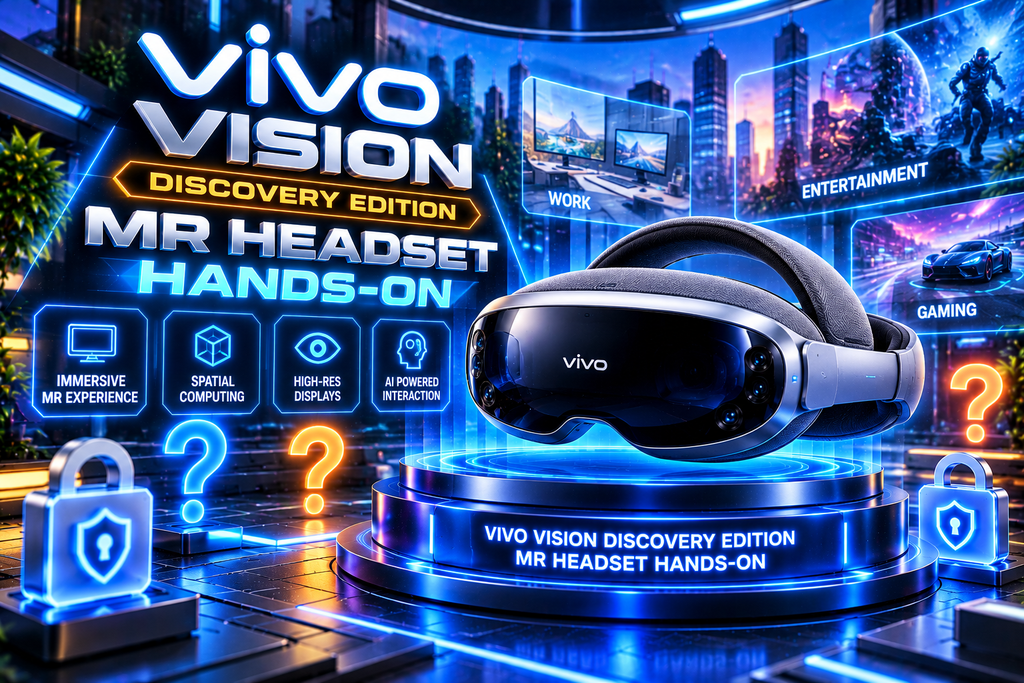
Imagine opening multiple virtual screens around you, watching a movie on a cinema-sized display, or interacting with digital objects simply by looking at them and pinching your fingers. That is the promise of mixed reality (MR), and Vivo wants to make this experience part of its growing technology ecosystem.
The Vivo Vision Discovery Edition MR Headset Hands-On experience offers an early look at the company’s ambitions beyond smartphones. Showcased in India at the Vivo NEXT event on October 6, 2026, the headset combines dual 8K Micro-OLED displays, eye tracking, hand gestures, and a dedicated spatial-computing operating system.
The device was previously introduced in China and is now available to experience at selected Vivo stores in India. However, this is not yet a conventional consumer product with a confirmed Indian retail price.
So, what is it like to use? Does the hardware feel comfortable, are the controls intuitive, and could the headset become useful beyond watching immersive videos?
Based on published hands-on reports and Vivo’s official specifications, here is what you should know.https://pangeeks.com/wp-admin/post.php?post=539&action
Vivo Vision Discovery Edition: Key Specifications
Feature
Details
Device type
Mixed-reality headset
Weight
Approximately 398 grams
Processor
Qualcomm Snapdragon XR2+ Gen 2
Displays
Dual binocular Micro-OLED
Advertised resolution
3,840 × 3,552 pixels per eye
Combined binocular resolution
Approximately 8K
Colour coverage
94% DCI-P3, according to Vivo
Operating system
OriginOS Vision
Controls
Eye tracking and hand gestures
Virtual cinema
Advertised 120-foot screen experience
Battery
Separate external battery pack
India price
Not announced
India retail availability
No confirmed consumer sale date
Specifications are based on Vivo’s published information and product demonstrations. The headset’s advertised display resolution describes the combined binocular display system; it should not be interpreted as an 8K image for each eye.
- Design and Comfort: Lighter Than It Looks
At first glance, the Vivo Vision Discovery Edition resembles a compact visor with a curved front panel, a padded face interface, and an adjustable head strap. Its design will look familiar to anyone who has followed premium mixed-reality headsets.
The headline number is its 398-gram weight. That is relatively light for a device with this type of display and sensor hardware, although the separate battery pack and cable also form part of the overall setup.
In its official announcement, Vivo says the headset uses an ergonomically designed structure with four light-seal sizes and eight foam-padding options. These options allow users to find a better fit around the face and reduce unwanted light entering from the sides.
What Did Hands-On Reports Find?
In its first-impressions report, Gadgets 360 described the headset as relatively comfortable despite its substantial appearance. The reviewer wore it for approximately 15 minutes and reported no eye strain or headache during that brief session.
A separate 91mobiles hands-on also highlighted the headset’s weight and adjustable fit.
These are encouraging early observations, but a short demonstration cannot establish long-term comfort. Facial shape, nose pressure, prescription lenses, strap adjustment, and heat can all affect the experience.
For anyone considering an MR headset, comfort matters just as much as resolution. Even the sharpest display becomes less appealing if the device feels uncomfortable after half an hour.
- Dual 8K Micro-OLED Displays: A Big Visual Ambition
The display system is one of the Vivo Vision Discovery Edition’s main attractions.
Vivo equips the headset with dual binocular Micro-OLED displays, each offering a reported resolution of 3,840 × 3,552 pixels. The company also advertises 94% DCI-P3 colour coverage and Delta E colour accuracy below 2.
These figures suggest that Vivo is aiming for detailed visuals and colour reproduction suitable for immersive entertainment.
What Does This Mean in Practice?
High-resolution displays can make virtual objects, text, and images appear more detailed. Micro-OLED technology can also provide strong contrast, which is useful when scenes contain dark backgrounds and bright highlights.
However, resolution alone does not determine display quality. The viewing experience also depends on lens design, brightness, optical clarity, field of view, and how effectively the headset aligns the displays with the user’s eyes.
During demonstrations, reviewers reported sharp visuals and an immersive viewing experience. Still, a complete assessment would require more extensive testing across different environments and applications.
For movie lovers, the combination of high-resolution displays and a large virtual screen could be one of the headset’s strongest selling points.
- Eye Tracking and Hand Gestures: Less Dependence on Controllers
Traditional computers rely on a mouse, keyboard, or touchscreen. Mixed-reality headsets introduce another approach: users can look at an object and use a hand gesture to interact with it.
The Vivo Vision Discovery Edition supports eye tracking and hand-based controls through OriginOS Vision.
In practice, the user looks at a menu item and pinches the thumb and index finger to select it. Similar gestures can be used to interact with windows and virtual objects.
How Natural Is the Interface?
Published hands-on reports describe the basic controls as relatively intuitive after users become familiar with them. Gadgets 360’s demonstration included selecting interface elements, opening applications, and moving windows around the virtual environment.
This approach has a clear advantage: users do not necessarily need to hold a separate controller just to navigate menus.
However, gesture-based interfaces also have limitations. Hand tracking can depend on where the hands are positioned, the lighting conditions, and how reliably the sensors detect movements. Precise interactions may require practice.
Vivo’s approach looks promising, but its usefulness will depend on consistency. A spatial interface should make everyday tasks easier rather than forcing users to learn complicated gestures for simple actions.
- OriginOS Vision: A Digital Workspace Around You
The headset runs OriginOS Vision, Vivo’s operating system designed specifically for mixed reality.
Instead of presenting every application on a physical screen, the system places windows and digital content in the surrounding virtual space. Users can open supported applications, position windows, and interact with them through eye and hand controls.
Published demonstrations have shown applications such as a browser, file manager, album viewer, media player, and games.
The Biggest Challenge Is the App Ecosystem
A mixed-reality headset needs more than impressive hardware. It also needs software that gives people a reason to wear it regularly.
A small collection of demonstration applications can show what a headset is capable of, but a successful consumer product needs broader support for entertainment, productivity, communication, and creative work.
Vivo will need to make sure developers can build useful applications and that the software remains easy to navigate.
For example, a virtual workspace could be valuable for someone who wants multiple windows without purchasing additional monitors. But the experience becomes much less practical if essential applications are missing or awkward to control.
The hardware creates the environment; the software determines how useful that environment becomes.
- A Virtual Cinema With a 120-Foot Screen
One of Vivo’s most attention-grabbing claims is its virtual cinema experience, advertised as equivalent to watching content on a 120-foot screen.
The idea is simple: rather than watching a film on a phone, laptop, or television, users can create a large virtual viewing environment around themselves.
This could be especially attractive to people who travel frequently, live in smaller homes, or enjoy watching films without needing a large physical television.
What About 360-Degree Content?
The headset also supports immersive 360-degree environments and spatial images. These experiences allow users to look around digital scenes instead of viewing everything through a fixed rectangular screen.
A virtual cinema and an interactive 360-degree environment serve different purposes. The former focuses on watching content, while the latter can make users feel more present inside a scene.
The quality of both experiences depends on content availability and display performance. A large virtual screen is impressive, but the headset still needs good video playback, comfortable viewing, and a strong selection of compatible content to become a regular entertainment device.
- Mixed-Reality Gaming: Can Digital Worlds Blend With Real Rooms?
Gaming is another area where the Vivo Vision Discovery Edition could stand out.
Unlike a traditional monitor, a mixed-reality headset can combine digital elements with a view of the user’s surroundings. This creates opportunities for games that use the room as part of the experience.
Vivo’s demonstrations have included mixed-reality gaming and immersive virtual environments.
However, the overall gaming experience depends on several factors:
Tracking accuracy: The headset needs to understand the user’s movement and position.
Performance: Games should respond quickly and run smoothly.
Comfort: Weight and heat become more noticeable during longer sessions.
Game selection: A limited library can reduce long-term appeal.
Interaction design: Gestures should feel responsive rather than frustrating.
For casual immersive gaming, the headset’s controller-free interaction may be appealing. Dedicated gamers, however, should wait for broader software support and independent testing before treating it as a replacement for a conventional gaming setup.
- External Battery: A Practical Advantage With a Trade-Off
The Vivo Vision Discovery Edition uses a separate battery pack connected to the headset through a dedicated cable.
Moving the battery away from the main visor can help reduce the weight carried on the user’s face. It also makes the headset’s design more manageable than placing every component inside the front housing.
But the external pack introduces a cable and another device to carry.
The battery arrangement may therefore suit seated activities such as watching films or using virtual workspaces better than activities that involve a lot of movement.
Vivo’s official product information and hands-on coverage describe the external battery, but buyers should look for confirmed battery-life figures and charging details before making a purchase decision.
- Vivo Vision Discovery Edition vs Apple Vision Pro
The Apple Vision Pro is an obvious comparison because both products focus on spatial computing, immersive displays, and gesture-based interaction.
Category
Vivo Vision Discovery Edition
Apple Vision Pro
Primary purpose
Mixed reality and spatial computing
Spatial computing and immersive media
Display technology
Dual Micro-OLED
Micro-OLED
Display resolution
3,840 × 3,552 pixels per eye, reported
Varies by model and generation
Interaction
Eye tracking and hand gestures
Eye tracking and hand gestures
Weight
Approximately 398 g for the headset
Heavier overall headset, depending on version
Software
OriginOS Vision
visionOS
India availability
Demonstrations at selected Vivo stores; no confirmed retail price
Availability depends on Apple’s current market distribution
The table highlights the broad similarities, not a definitive performance ranking. Exact hardware, software capabilities, and market availability vary by model.
Vivo’s lower headset weight is a promising design point, but weight alone does not make one product better. Comfort, optical quality, application support, reliability, and price all matter.
Apple’s established spatial-computing ecosystem is also an important comparison point. Vivo will need to demonstrate that its own platform can offer a similarly compelling range of experiences over time.
- Vivo Vision Discovery Edition: India Availability and Price
Vivo showcased the headset in India at its Vivo NEXT event on October 6, 2026. The company has arranged demonstration opportunities at 15 Vivo Exclusive Stores across 10 cities.
The cities listed in Vivo’s announcement include Bengaluru, Ahmedabad, Coimbatore, Indore, Dehradun, Delhi, Patna, Kolkata, Nagpur, and Mumbai.
The company has not announced a confirmed Indian retail price or consumer sale date. The current showcase is an opportunity to experience the technology rather than evidence that the headset is available for general purchase.
If you are interested, check Vivo India’s official announcement for the latest information and demonstration details.
Final Verdict: A Promising First Step Into Mixed Reality
The Vivo Vision Discovery Edition shows that Vivo is looking beyond smartphones and exploring a new way for people to interact with digital content.
Its dual 8K Micro-OLED displays, eye tracking, gesture controls, relatively light headset design, and virtual cinema experience make it an interesting piece of technology. Early hands-on reports suggest that the experience can be impressive, especially when navigating virtual windows or viewing immersive content.
The biggest unanswered questions concern software maturity, long-session comfort, battery endurance, application availability, pricing, and consumer access.