Introduction: Can Wireless Headphones Deliver Truly Detailed Sound?
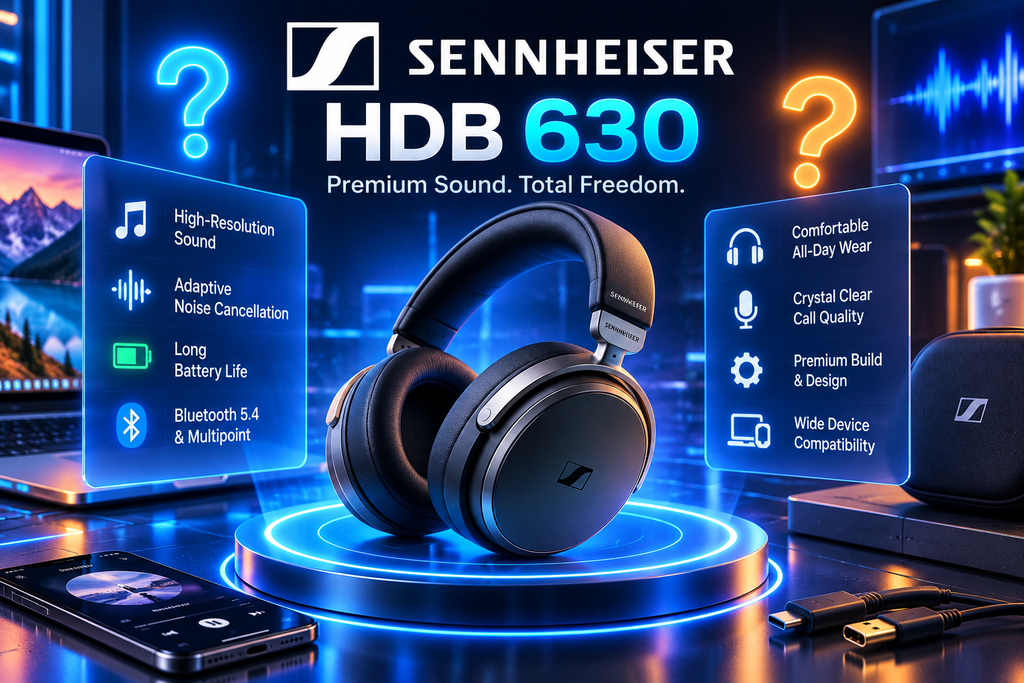
Imagine listening to your favourite song and noticing a quiet guitar detail you had never paid attention to before. The vocals sound natural, the bass feels controlled, and every instrument has room to breathe. That is the experience many music lovers want from premium headphones.
The Sennheiser HDB 630 is designed for listeners who want more than convenient wireless audio. It combines a high-quality sound-focused design with active noise cancellation (ANC), extensive sound customization, long battery life, and high-resolution audio support.
Rather than focusing only on flashy features, Sennheiser’s approach centres on giving listeners greater control over how their music sounds, whether they are working at a desk, travelling, or relaxing at home.
But premium headphones face a difficult challenge: they must deliver excellent sound while remaining comfortable, practical, and easy to use every day. A wide range of audio settings means little if the headphones become uncomfortable after an hour or fail to block distracting noise on a commute.
In this guide, we’ll examine the Sennheiser HDB 630’s design, sound quality, noise cancellation, connectivity, battery life, and value for money, along with the factors to consider before purchasing.https://pangeeks.com/wp-admin/post.php?post=595&action
- Sennheiser HDB 630: Key Specifications
Sennheiser HDB 630
Premium closed-back wireless headphones
42 mm dynamic drivers
Hybrid active noise cancellation
Up to 60 hours of battery life
Bluetooth 5.2 with aptX Adaptive
Parametric EQ and crossfeed
USB-C and 3.5 mm wired listening
The HDB 630 is built around a 42 mm dynamic transducer and a closed-back over-ear design. It weighs approximately 311 grams according to Sennheiser’s product specifications, making it a substantial pair of headphones rather than an ultra-light travel accessory.
Sennheiser
+1
Specification Sennheiser HDB 630
Driver size 42 mm dynamic
Weight Approximately 311 g
Bluetooth Version 5.2
Supported codecs SBC, AAC, aptX, aptX HD, aptX Adaptive
Maximum advertised battery life Up to 60 hours with ANC
Audio resolution Up to 24-bit/96 kHz through supported connections
Sound customization Parametric EQ and crossfeed
Charging and digital audio USB-C
Wired analogue connection 3.5 mm detachable cable
Included accessory BTD 700 USB-C Bluetooth dongle
Water resistance No IP rating specified
These figures describe the manufacturer’s stated specifications. Actual battery life and audio performance depend on the listening configuration, connected device, and operating conditions.
Sennheiser
+1
- Sound Quality: Designed for Detail and Balance
Sound quality is where the Sennheiser HDB 630 aims to distinguish itself from headphones designed primarily around bass-heavy entertainment or lifestyle features.
Sennheiser describes its tuning as neutral and reference-oriented. The goal is to reproduce music with clear vocals, detailed instruments, controlled bass, and a balanced overall presentation.
What does neutral sound mean?
A neutral sound signature aims to avoid excessively boosting one part of the frequency range at the expense of another.
For example, a bass-heavy headphone may make electronic music feel exciting but can sometimes make bass instruments dominate acoustic recordings. A more balanced headphone aims to preserve the relationship between the bass, vocals, and other instruments.
That approach can be especially useful when listening to:
- Acoustic music and live recordings.
- Jazz, classical, and instrumental compositions.
- Vocally focused tracks and podcasts.
- Rock and electronic music with complex arrangements.
- High-quality recordings where small details matter.
The HDB 630 also supports high-resolution audio through compatible connections. With the included BTD 700 dongle, USB-C audio, or an analogue connection, the system supports up to 24-bit/96 kHz under specified conditions.
Sennheiser
+1
One important distinction: high-resolution support does not automatically make music sound better. The source recording, mastering, headphones, fit, and listening environment all affect what you hear.
A wide soundstage through crossfeed
The HDB 630 includes a crossfeed feature that blends a controlled amount of the left and right audio channels.
Traditional stereo headphones can make instruments appear sharply separated between the ears. Crossfeed can make some recordings feel more natural by introducing a subtle amount of the opposite channel into each ear.
This is particularly interesting for people who listen to older stereo recordings or long instrumental sessions. Whether it improves the experience is subjective, so it is worth trying both settings.
3. High-Resolution Wireless Audio and the BTD 700 Dongle
The included BTD 700 USB-C Bluetooth dongle is one of the HDB 630’s most useful accessories.
Many wireless headphones rely on the codecs supported by the connected phone or computer. Even if a headphone supports a high-quality codec, a device that does not support it may fall back to another option.
The BTD 700 is designed to make high-quality wireless audio more accessible across compatible USB-C devices. It supports the aptX family of codecs, including aptX Adaptive, which can adjust audio transmission according to supported conditions.
Why is this useful?
Suppose you listen to music on a laptop that does not offer the Bluetooth codec you want. A compatible dongle can provide another way to establish the intended audio connection.
The headphones also support wired listening through USB-C or the detachable 3.5 mm audio cable. That flexibility makes them suitable for desktop listening, travel, and compatible portable devices.
However, the actual codec and resolution depend on the source, connection, software, and playback settings. A high-resolution label is not a guarantee that every Bluetooth session will operate at 24-bit/96 kHz.
For the technical details, consult the official HDB 630 specifications.
4. Active Noise Cancellation: Better Focus at Home and on the Move
The Sennheiser HDB 630 features hybrid active noise cancellation using four microphones. ANC works by monitoring environmental sound and generating an opposing signal to reduce some of the noise reaching your ears.
In everyday use, this technology is most helpful for reducing steady background sounds, such as ventilation, engine noise, and general office ambience.
Independent testing by RTINGS found the HDB 630’s ANC effective for office environments, although low-frequency bass noise remains a limitation. The review also highlights its balanced sound and extensive equalizer controls.
RTINGS.com
When is ANC most useful?
- Working from home: Reduce distracting background noise while concentrating.
- Travelling: Make steady aircraft or train noise less intrusive.
- Studying: Create a quieter listening environment.
- Listening at a café: Reduce some ambient noise without necessarily increasing your music volume.
ANC does not eliminate every sound. Nearby conversations, sudden noises, and certain low-frequency sounds may remain audible.
For safety, keep your surroundings in mind when walking near traffic or travelling through busy public areas.
5. Personalize Your Sound With Parametric EQ
Many wireless headphones offer a few basic presets, such as Bass Boost, Vocal, and Treble. The HDB 630 goes further with a parametric equalizer through the Sennheiser Smart Control Plus app.
A parametric EQ lets you adjust specific frequency ranges, their strength, and the width of the affected range. This provides more control than simply increasing or decreasing bass.
For example, you could experiment with a small reduction in a frequency range that makes vocals sound harsh, or adjust the bass to suit your preferred music style.
How to get started
- Connect the headphones to a compatible device.
- Open the Sennheiser Smart Control Plus app.
- Locate the equalizer settings.
- Start with the default sound profile.
- Make small adjustments and compare the results using familiar tracks.
Avoid making several large changes at once. Small adjustments make it easier to identify which settings genuinely improve your listening experience.
The crossfeed feature is another useful option for listeners who want to adjust the presentation of stereo recordings.
These controls make the HDB 630 appealing to people who enjoy experimenting with sound rather than accepting a fixed tuning.
6. Battery Life: Up to 60 Hours of Listening
Battery life is a major strength of the Sennheiser HDB 630.
Sennheiser advertises up to 60 hours of playback with ANC enabled. This is a manufacturer-rated maximum, and actual endurance depends on volume, connection type, and other settings.
Sennheiser
+1
For someone listening for two or three hours a day, that advertised capacity could mean several days between charges.
It is also helpful for travellers who prefer not to carry a charger everywhere they go.
The USB-C connection supports charging, and the included cable can also be used for compatible digital audio connections.
Simple battery-saving tips
- Keep the volume at a comfortable level.
- Disconnect unused devices when appropriate.
- Switch off the headphones when you finish listening.
- Charge them before long journeys.
- Check the remaining battery in the companion app or through supported device indicators.
Battery life is particularly important in premium headphones because frequent charging can interrupt an otherwise convenient wireless experience.
- Design, Comfort and Build Quality
The HDB 630 uses a closed-back over-ear design with synthetic leatherette ear pads. Its full-size ear cups are intended to surround the ears rather than rest directly on them.
That design can help with passive isolation and provide a more immersive listening experience.
However, comfort is personal. Head shape, glasses, ear size, clamping force, and the amount of padding can all affect how the headphones feel over extended periods.
At approximately 311 grams, the HDB 630 is not the lightest option in its category. Some listeners may appreciate its substantial construction, while others may prefer a lighter model for all-day use.
Independent testing has also noted that headband padding may feel insufficient for some users. Trying the headphones on before purchasing is sensible if you plan to wear them throughout the working day.
Sennheiser Hearing
+1
One additional consideration: the HDB 630 does not have a specified IP water- or sweat-resistance rating. It is therefore not the ideal choice for intense workouts or wet outdoor conditions.
8. Sennheiser HDB 630 vs Momentum 4 Wireless
The HDB 630 belongs to Sennheiser’s premium wireless headphone family, but it serves a somewhat different purpose from the popular Momentum 4 Wireless.
The HDB 630 places particular emphasis on neutral sound, detailed audio customization, and its included Bluetooth dongle. The Momentum 4 Wireless is also a strong premium option, especially for listeners seeking a more conventional all-purpose wireless headphone experience.
Feature HDB 630 Momentum 4 Wireless
Main focus Audiophile-oriented listening Premium everyday listening
Driver design 42 mm dynamic 42 mm dynamic
Active noise cancellation Hybrid ANC Adaptive ANC
Battery life Up to 60 hours Up to 60 hours
High-quality wireless audio aptX Adaptive and included BTD 700 dongle Codec support depends on model and source
Sound customization Parametric EQ and crossfeed App-based sound customization
Wired listening USB-C and 3.5 mm USB-C and analogue options
Best for Listeners who want detailed tuning control General music, commuting, and everyday use
Both models offer long battery life and wireless convenience. The right choice depends on the sound profile you prefer, the devices you use, and the importance of the bundled dongle.
Check the manufacturer’s current Momentum 4 Wireless product information before comparing prices and specifications, as regional versions and offers can vary.
9. Sennheiser HDB 630 Price in India
At the time of writing, Sennheiser India’s official store lists the HDB 630 with a maximum retail price of ₹54,990. A promotional price of ₹41,490 has also appeared on its product listing, although prices and discounts can change.
Sennheiser
+1
At this price, the HDB 630 competes with premium wireless headphones from Sony, Bose, and other established audio brands.
Before purchasing, compare the final checkout price, warranty, return policy, and included accessories. The BTD 700 dongle is an important part of the package, so confirm whether it is included in the exact listing you are considering.
For current availability, use the official Sennheiser India product page.
10. Who Should Buy the Sennheiser HDB 630?
The HDB 630 is best suited to listeners who care about sound quality and want more control over their listening experience.
It may be a good choice if you:
- Listen to music for several hours each day.
- Prefer balanced sound over exaggerated bass.
- Want a parametric equalizer and crossfeed.
- Need ANC for office work or travel.
- Use a laptop, smartphone, or other compatible USB-C audio device.
- Appreciate both wireless and wired listening options.
You may want to consider alternatives if you: - Prefer very lightweight headphones for long sessions.
- Need certified water or sweat resistance.
- Primarily play competitive games where low latency is essential.
- Want a lower-cost pair of everyday headphones.
- Expect ANC to eliminate virtually all background noise.
The HDB 630 is also not a substitute for dedicated studio-monitoring equipment in every professional workflow. Its sound customization is useful, but critical mixing and mastering require a properly controlled listening environment and a reference setup appropriate to the work.
Conclusion: Is the Sennheiser HDB 630 Worth Buying?
The Sennheiser HDB 630 combines a neutral sound profile, 42 mm dynamic drivers, adaptive noise cancellation, extensive EQ controls, and up to 60 hours of advertised battery life. Its included BTD 700 dongle and wired listening options add flexibility for people who use multiple devices.
Its biggest strength is the balance between audiophile-oriented sound and everyday wireless convenience. Instead of relying only on a collection of lifestyle features, it gives listeners meaningful control over how their music is presented.
There are trade-offs. The headphones are relatively substantial, comfort will vary between users, and noise cancellation is not perfect in every environment. The premium price also means buyers should compare competing models before committing.