Introduction: A New Kind of AI-Powered Laptop
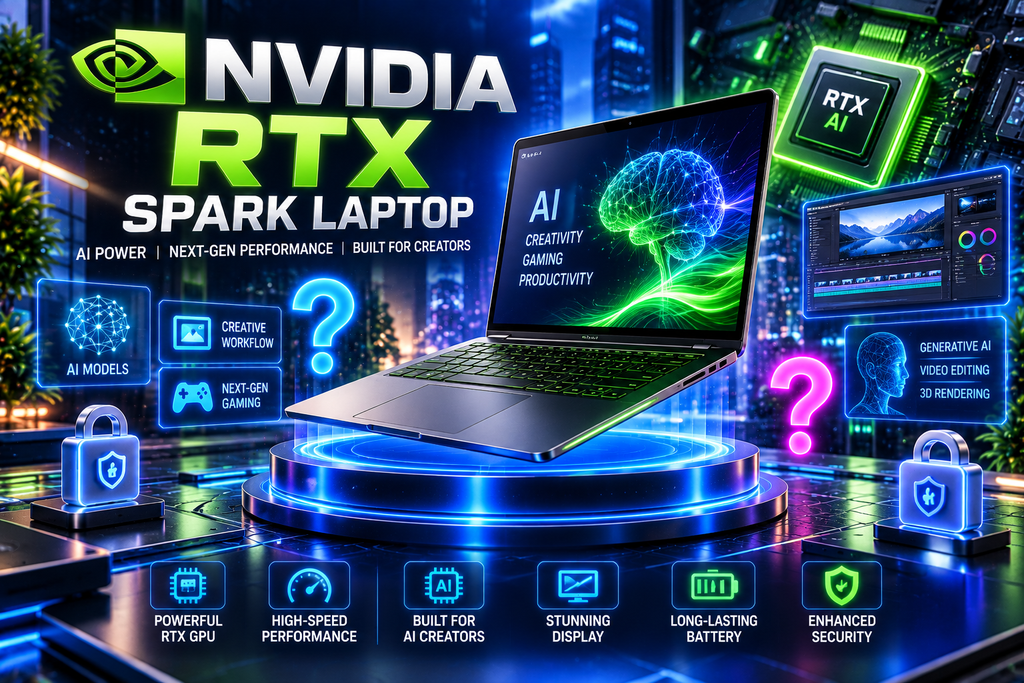
Imagine having a laptop that can run AI models locally, generate creative assets, edit demanding video projects, and play modern games—all without depending on a cloud service for every task. That is the idea behind the NVIDIA RTX Spark Laptop, a new category of Windows computer designed to bring AI computing and powerful graphics together.
Announced as available on October 16, 2026, NVIDIA RTX Spark combines a Grace CPU with Blackwell RTX graphics and a shared memory architecture. Rather than being designed exclusively for gamers, it targets AI developers, creative professionals, and users who want substantial computing power in a portable device.
The platform is available through laptop manufacturers including ASUS, Dell, HP, Lenovo, Microsoft, and MSI. NVIDIA lists a starting price of $2,399, although individual laptop prices vary considerably by configuration. NVIDIA’s official announcement explains the platform’s main goals.
But impressive specifications do not automatically make a laptop the right purchase. Early reviews have praised its AI and graphics capabilities while raising concerns about price, battery life, heat, and software compatibility.
Let’s explore what the NVIDIA RTX Spark Laptop actually offers and whether it deserves a place on your shopping list.
What Is the NVIDIA RTX Spark Laptop?
NVIDIA RTX Spark is a computing platform built around a system-on-chip (SoC). It combines an NVIDIA Grace CPU and a Blackwell RTX GPU into a single design, with both processors accessing a shared pool of memory.
Traditional gaming laptops generally use an Intel or AMD processor alongside a separate graphics processor. RTX Spark takes a different approach, aiming to balance graphics performance, AI acceleration, and power efficiency in slimmer Windows laptops.
The platform supports NVIDIA’s CUDA software ecosystem, AI acceleration tools, ray tracing, DLSS, and other RTX technologies.
Its biggest selling point is flexibility: the same machine can be used for local AI development, 3D creation, video production, and gaming.
NVIDIA RTX Spark Laptop: Key Specificationshttps://pangeeks.com/wp-admin/post.php?post=516&action
Feature
RTX Spark platform
Processor
NVIDIA Grace CPU
CPU cores
Up to 20
Graphics architecture
NVIDIA Blackwell RTX
GPU CUDA cores
Up to 6,144
Unified memory
Up to 128GB LPDDR5X
AI performance
Up to 1 petaflop FP4
Operating system
Windows 11
Gaming technologies
Ray tracing, DLSS, Reflex
Creative technologies
CUDA, TensorRT, NVIDIA Studio
Laptop sizes
Approximately 14–16 inches, depending on model
Starting price announced
US$2,399
Availability
From October 16, 2026
These are platform-level maximum specifications, not a guarantee that every laptop has the same hardware. NVIDIA also lists a lower configuration with an 18-core CPU, a 5,120-core GPU, and up to 64GB of unified memory.
Check the official NVIDIA RTX Spark product page before comparing individual models.
- AI Performance: The Main Reason to Consider RTX Spark
The most interesting feature of the NVIDIA RTX Spark Laptop is its focus on running AI workloads locally.
Many AI tools depend on cloud servers. Local AI, by contrast, allows supported models to run directly on your computer. This can be useful when working with private documents, experimenting with language models, or developing applications that need frequent testing.
RTX Spark offers up to 128GB of unified memory and up to one petaflop of FP4 AI computing performance. FP4 is a low-precision format that can improve inference efficiency for supported models, although actual results depend on the software and model being used.
What can you do with local AI?
Run compatible language models without sending every prompt to a cloud service.
Experiment with AI agents and automated workflows.
Generate images and other creative assets using supported tools.
Prototype and test AI applications.
Work with large datasets and models that need substantial memory.
For example, a developer building a customer-support chatbot could use local models to test prompts, evaluate outputs, and refine the application. A designer could explore image-generation workflows without paying for every cloud inference request.
However, local AI is not automatically cheaper or more private in every situation. Applications may still connect to online services, and running demanding models can consume considerable battery power.
NVIDIA provides more information about its local AI approach on its RTX Spark product page.
- Blackwell Graphics: More Than a Gaming Feature
RTX Spark’s Blackwell graphics architecture gives it capabilities beyond conventional productivity laptops.
Its GPU includes CUDA cores for parallel processing and specialised hardware for AI and ray tracing. This matters for workloads such as 3D rendering, effects-heavy video editing, simulation, and compatible creative applications.
The platform also supports NVIDIA technologies such as DLSS, Reflex, G-SYNC, and hardware-accelerated video processing.
Who benefits most?
A video editor working with high-resolution footage may benefit from accelerated encoding and decoding. A 3D artist may value faster rendering and the ability to work with larger scenes. AI developers can use the same GPU architecture through NVIDIA’s software ecosystem.
Still, core counts alone do not determine performance. Cooling, power limits, memory bandwidth, application optimisation, and the specific laptop design all influence the final result.
- Gaming Performance: Is RTX Spark a Gaming Laptop Alternative?
NVIDIA is positioning RTX Spark as a machine that can handle gaming alongside AI and creative work.
Supported features include ray tracing, DLSS, and Reflex. DLSS can improve performance in compatible games through AI-assisted rendering techniques, while Reflex is designed to reduce system latency.
NVIDIA has advertised demanding games running at 1440p with frame rates above 100 frames per second under its stated conditions. That figure should not be treated as a universal result for every game or configuration, especially when frame-generation technology contributes to the displayed frame rate.
Early independent testing has produced a mixed picture. PC Gamer’s review found promising gaming capability but noted that the high price and compatibility limitations make it difficult to recommend for gaming alone.
The Windows on Arm challenge
RTX Spark uses an Arm-based CPU. Windows 11 can run many traditional applications through emulation, but not every game, driver, anti-cheat system, or specialised program will work perfectly.
Native Arm support and software optimisation should improve the experience over time. Nevertheless, buyers should verify their favourite games before purchasing.
Gaming verdict: RTX Spark is an interesting option for people who want gaming and AI in one computer. Dedicated gaming laptops may offer better value and more predictable compatibility for players who mainly want high frame rates.
- Unified Memory: Why 128GB Could Matter
One of RTX Spark’s most distinctive features is unified memory.
In many traditional gaming laptops, system RAM and dedicated graphics memory are separate. RTX Spark allows the CPU and GPU to access a shared memory pool, with high-end configurations offering up to 128GB.
This is particularly useful for certain AI workloads, where model weights and supporting data can occupy substantial memory. It can also help with large creative projects.
Workload
Potential benefit
Local AI
More room for large models and data
3D rendering
Greater flexibility for complex scenes
Video production
Supports demanding memory-intensive workflows
Software development
Useful for AI prototyping and testing
Gaming
Can support graphics workloads, but does not guarantee higher frame rates
Unified memory is not identical to dedicated graphics memory. Capacity, bandwidth, and how efficiently an application uses memory still matter.
Another practical consideration is upgradability: the laptop’s memory is generally integrated, so buyers should choose their configuration carefully rather than expecting to add more RAM later.
- Design, Portability and Battery Life
RTX Spark laptops are designed for the premium end of the market. NVIDIA has described systems as thin as approximately 14mm and weighing around three pounds, depending on the model.
Manufacturers offer different designs, including creative-focused laptops with high-quality OLED displays, premium keyboards, and metal chassis.
Portability is appealing for professionals who move between offices, studios, and home workspaces. A single laptop could potentially replace separate computers for creative production and local AI experimentation.
What do early reviews say about battery life?
Results vary by model and test. For example, Tom’s Guide reported 12 hours and 26 minutes in its web-browsing battery test for the RTX Spark-powered ASUS ProArt P16. Other reviews have reported shorter endurance under different workloads and conditions.
These results are not directly interchangeable: screen brightness, test methods, battery capacity, and background activity all affect battery life. Running local AI models or demanding games will generally consume more power than browsing the web.
See Tom’s Guide’s ASUS ProArt P16 RTX Spark review for a model-specific assessment.
The practical lesson is simple: do not assume every RTX Spark laptop delivers the same battery life just because it uses the same platform.
- Price and Availability in India
NVIDIA announced RTX Spark laptops starting at US$2,399. Actual retail prices depend on the manufacturer, memory capacity, storage, display, and overall build quality. Some premium configurations cost considerably more.
For Indian buyers, local availability, import costs, taxes, and warranty coverage can affect the final price. A direct currency conversion from US dollars is not a reliable estimate of the Indian retail price.
Before purchasing, check:
The exact CPU and GPU configuration.
Whether the laptop includes 64GB or 128GB of unified memory.
SSD capacity and whether storage can be upgraded.
Local warranty and authorised service availability.
Compatibility with your essential software and games.
Independent reviews of the specific model.
At this price level, buyers should compare RTX Spark with premium gaming laptops, creator laptops, and high-end Apple MacBook Pro configurations.
- NVIDIA RTX Spark vs Traditional Gaming Laptops
Category
NVIDIA RTX Spark
Traditional gaming laptop
Primary focus
Local AI, creative work, and gaming
Often gaming performance first
CPU architecture
Arm-based Grace
Commonly x86-based Intel or AMD
Graphics
Blackwell RTX GPU in the SoC
Usually a separate discrete GPU
Memory
Shared unified memory
System RAM plus dedicated GPU memory
AI development
Designed around NVIDIA’s CUDA ecosystem
Depends on GPU, memory, and software
Game compatibility
Some Arm compatibility considerations
Generally broader x86 compatibility
Upgrade options
Memory generally fixed
Depends on model
Best suited to
AI developers and mixed creative workflows
Gamers seeking performance and value
Neither platform is automatically better. RTX Spark’s advantage is its combination of local AI capability, shared memory, and RTX graphics. Conventional gaming laptops may remain the more sensible choice for buyers who prioritise game compatibility and price-to-performance.
- Pros and Cons
Pros
Up to 128GB of unified memory.
Strong focus on local AI development.
Blackwell graphics with RTX technologies.
CUDA and TensorRT support.
Potential for demanding creative workflows.
Slim premium laptop designs.
Can combine AI, creation, and gaming in one device.
Cons
Premium starting price.
Performance varies by laptop configuration.
Battery life depends heavily on workload.
Heat and fan noise can become noticeable.
Some software and games may have Arm compatibility issues.
Memory is generally not user-upgradeable.
May be excessive for everyday productivity or gaming alone.
- Who Should Buy the NVIDIA RTX Spark Laptop?
The RTX Spark platform makes the most sense for users who will actively use its AI and graphics capabilities.
Consider it if you are:
An AI developer running compatible models locally.
A content creator using GPU-accelerated applications.
A 3D artist who needs substantial memory for large scenes.
A technical professional who wants AI experimentation and creative work in one portable computer.
Think twice if you are:
A student who mainly uses web browsers and office apps.
A gamer who wants the highest frame rates for the lowest price.
Dependent on specialised software that has not been verified on Windows on Arm.
Looking for the longest possible battery life under heavy workloads.
Planning to upgrade RAM in the future.
For general browsing, office work, and light entertainment, a much less expensive laptop may provide everything you need.
Frequently Asked Questions
Is the NVIDIA RTX Spark Laptop an official product?
Yes. NVIDIA announced RTX Spark laptops as available from October 16, 2026. RTX Spark is a platform used by multiple manufacturers rather than a single laptop model.
How much memory does RTX Spark support?
The highest-end platform configuration supports up to 128GB of unified LPDDR5X memory. Some laptops use lower-capacity configurations, so check the exact model.
Can RTX Spark run AI models offline?
Yes, it can run compatible local AI models without an internet connection. Some applications and features may still rely on cloud services.
Is RTX Spark good for gaming?
It supports modern RTX gaming technologies and can deliver strong results in compatible titles. However, performance and compatibility vary, and traditional gaming laptops may offer better value for gaming alone.
What is the NVIDIA RTX Spark Laptop price in India?
The announced US starting price is US$2,399, but that is not a confirmed Indian retail price. Check local listings and manufacturer warranty terms before buying.
Conclusion: Is the NVIDIA RTX Spark Laptop Worth Buying?
The NVIDIA RTX Spark Laptop platform introduces an ambitious approach to premium Windows computing. By combining a Grace CPU, Blackwell RTX graphics, and up to 128GB of unified memory, it aims to make local AI, creative production, and gaming possible in one portable machine.
Its biggest advantage is not simply gaming speed. It is the ability to run memory-intensive AI workloads alongside RTX-accelerated creative applications on a single computer.
However, the high price, Windows on Arm compatibility considerations, and model-dependent battery performance mean it will not be the right choice for everyone.
Our verdict: The NVIDIA RTX Spark Laptop is worth considering if you are an AI developer or creative professional who can genuinely use its local computing power. If you mainly want a laptop for gaming, studying, or everyday productivity, compare more affordable alternatives before making a decision.
Call to Action
Would you choose the NVIDIA RTX Spark Laptop for AI development, content creation, or gaming? Share your opinion in the comments, and explore more AI technology, graphics-card, and laptop guides on our blog.