Introduction: Xiaomi’s New Tablets Aim for Work and Entertainment
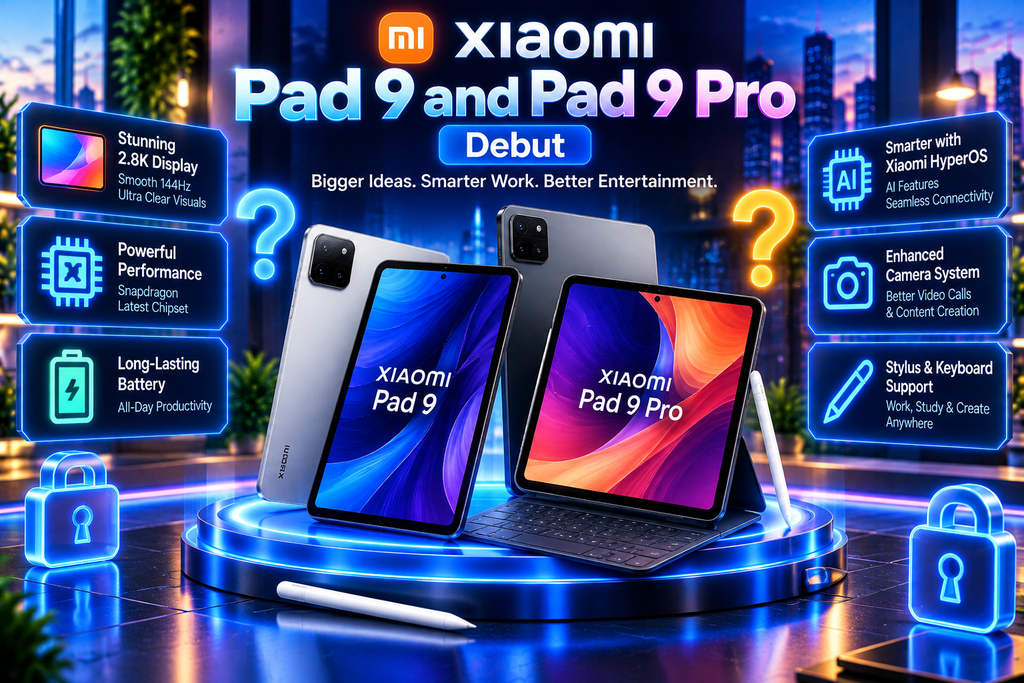
A tablet should do more than offer a bigger screen than a smartphone. It should make reading easier, video streaming more immersive, multitasking more comfortable and creative work less dependent on a laptop.
The Xiaomi Pad 9 and Pad 9 Pro debut brings two new Android tablets to the market, targeting users who want a balance of entertainment, productivity and high-end performance. Announced in China in September 2026, the tablets share a high-resolution 144Hz display specification but differ in screen size, processing power, camera hardware, battery capacity and charging speed.
The standard Xiaomi Pad 9 is designed for users who value portability and everyday versatility. The Pad 9 Pro, meanwhile, offers a larger screen and a more powerful processor for demanding workloads.
According to Beebom Gadgets’ launch report, both models also run HyperOS 4 and use Qualcomm Snapdragon chipsets.
So, which tablet offers better value? Let’s explore their specifications, features, pricing and differences to help you decide.
Xiaomi Pad 9 and Pad 9 Pro: Key Specificationshttps://pangeeks.com/wp-admin/post.php?post=359&action
Feature
Xiaomi Pad 9
Xiaomi Pad 9 Pro
Display
11.2-inch LCD
12.5-inch LCD
Resolution
3200 × 2136 pixels
3200 × 2136 pixels
Refresh rate
Up to 144Hz
Up to 144Hz
Processor
Snapdragon 8s Gen 4
Snapdragon 8 Gen 5
Rear camera
13MP
50MP
Front camera
8MP
32MP
Battery
9,720mAh
11,000mAh
Wired charging
45W
67W
RAM
Up to 12GB
Up to 16GB
Maximum listed storage
256GB
256GB
Software
HyperOS 4
HyperOS 4
Audio
Four speakers with Dolby Atmos
Four speakers with Dolby Atmos
Stylus support
Yes, compatible accessories
Yes, compatible accessories
Starting China price
CNY 2,999
CNY 3,799
Specifications are based on launch coverage from FoneArena. Configurations and features may differ by region.
- Design and Display: Two Sizes for Different Users
The first major difference between the two tablets is their physical size.
The Xiaomi Pad 9 has an 11.2-inch display, making it a practical option for students, travellers and people who regularly carry their tablets between home, college and work. The Pad 9 Pro increases the screen size to 12.5 inches, providing more room for documents, spreadsheets, drawing applications and split-screen multitasking.
Both models feature a 3200 × 2136-pixel LCD panel with a 3:2 aspect ratio. This taller layout is particularly useful for reading articles, editing documents and browsing websites because it displays more vertical content than many widescreen tablet displays.
Why does the 144Hz refresh rate matter?
Both tablets support refresh rates of up to 144Hz. A higher refresh rate can make scrolling, animations and supported games appear smoother than on a conventional 60Hz display.
The screens also support HDR formats and a wide colour gamut, making them suitable for video streaming, digital artwork and photo viewing. The reported peak brightness differs between models and screen variants, so buyers should check the specifications of the exact version they intend to purchase.
Xiaomi also offers Soft Light Edition variants with matte, anti-reflective screen treatments. These may be especially useful for students and professionals who work under bright indoor lighting.
However, a matte display can affect how reflections, contrast and fine details appear. If you frequently watch films in a dark room, the standard glossy screen may be preferable.
- Performance: Snapdragon Chips for Everyday Productivity
The Xiaomi Pad 9 and Pad 9 Pro use different processors, reflecting their different target audiences.
Xiaomi Pad 9: Snapdragon 8s Gen 4
The standard model uses Qualcomm’s Snapdragon 8s Gen 4 platform. It is designed to provide strong performance for everyday tasks, entertainment, multitasking and gaming.
Potential uses include:
Attending online classes and video meetings.
Reading PDFs and taking digital notes.
Editing documents and presentations.
Playing demanding Android games.
Switching between multiple applications.
For most students and general users, the standard Pad 9 should offer substantial performance without requiring the additional cost of the Pro model.
Xiaomi Pad 9 Pro: Snapdragon 8 Gen 5
The Pro version steps up to Qualcomm’s Snapdragon 8 Gen 5 platform. Its higher-performance hardware is aimed at people who regularly use demanding applications, edit content or keep several applications open at once.
The Pro model also offers configurations with up to 16GB of RAM, compared with up to 12GB on the standard Pad 9.
More memory can help when switching between resource-intensive applications, although the benefit depends on the software and workload. It does not automatically make every app faster.
For gamers, the Pro’s additional processing headroom may be useful for demanding titles and higher graphics settings. Nevertheless, sustained performance also depends on thermal management, software optimisation and game compatibility.
- Battery Life and Charging: The Pro Has More Capacity
Battery life is an important consideration for anyone using a tablet throughout the day.
The Xiaomi Pad 9 includes a 9,720mAh battery, while the Pad 9 Pro increases capacity to 11,000mAh. Xiaomi’s published usage estimates for the Pro include up to 14.5 hours of short-video playback or up to 20 hours of online meetings under specified test conditions.
These figures are manufacturer estimates, not guarantees. Screen brightness, Wi-Fi strength, video resolution, applications and background activity can all affect real-world battery life.
Charging comparison
Xiaomi Pad 9: Up to 45W wired charging.
Xiaomi Pad 9 Pro: Up to 67W wired charging.
The Pro’s larger battery and faster charging are useful for people who frequently work away from a power outlet. Both models also support reverse charging, allowing them to supply power to compatible devices.
If portability matters more than maximum endurance, the standard Pad 9 may be sufficient. For users who spend long hours in meetings, editing applications or entertainment apps, the Pro’s larger battery may be more appealing.
- Camera Features: The Pro Is Better Equipped for Video Calls
Tablet cameras are often overlooked, but they matter for online classes, remote meetings, document scanning and casual photography.
The Xiaomi Pad 9 has a 13MP rear camera and an 8MP front camera. This should be adequate for scanning documents, taking reference photographs and attending video calls.
The Pad 9 Pro upgrades the camera system to a 50MP rear camera and a 32MP front camera.
The higher-resolution front camera may be useful for video meetings and content creation, although resolution alone does not guarantee better image quality. Lighting, sensor size, image processing and camera positioning also matter.
For most users, the front camera is more important than the rear camera on a tablet. A sharp image, reliable autofocus where available and clear audio can make a greater difference to the quality of online meetings than the number of megapixels.
If you mainly use your tablet for reading, streaming and note-taking, the standard Pad 9’s camera hardware should be adequate. Content creators and frequent video-call users may prefer the Pro.
- HyperOS 4 and Productivity Features
Both tablets launch with Xiaomi’s HyperOS 4 software. The interface is designed to connect Xiaomi devices and support productivity features across the company’s ecosystem.
Depending on the application and accessory, users can work with multiple windows, manage documents, take handwritten notes and use a compatible keyboard or stylus.
The tablets also support Xiaomi’s Focus Stylus Pro accessory, which is sold separately. A compatible keyboard can make writing reports, replying to emails and editing spreadsheets more comfortable.
Can these tablets replace a laptop?
For some users, yes—but not for everyone.
The Xiaomi Pad 9 and Pad 9 Pro may handle many everyday tasks, including web browsing, note-taking, document editing, online meetings and light content creation.
However, laptop replacement depends on the software you need. Some desktop applications have no equivalent Android version, while others offer fewer features on tablets. File management, external display support and specialised professional workflows may also differ.
Before purchasing a keyboard and stylus, check accessory compatibility and the cost of the complete setup. A tablet that initially appears affordable can become considerably more expensive when accessories are added.
- Xiaomi Pad 9 vs Pad 9 Pro: Which One Should You Choose?
The best option depends on how you plan to use your tablet.
User type
Recommended model
Reason
Students
Xiaomi Pad 9
More portable for notes, reading and classes
Casual users
Xiaomi Pad 9
Suitable for browsing and entertainment
Mobile gamers
Xiaomi Pad 9 Pro
More powerful processor and larger screen
Content creators
Xiaomi Pad 9 Pro
Higher-resolution cameras and more RAM
Frequent video-call users
Xiaomi Pad 9 Pro
Higher-resolution front camera
Users who multitask heavily
Xiaomi Pad 9 Pro
More memory and processing headroom
Budget-conscious buyers
Xiaomi Pad 9
Lower starting price
The most important point is that the standard Pad 9 is not necessarily the wrong choice simply because the Pro model has better hardware. Paying for extra performance only makes sense if your applications and daily activities can take advantage of it.
- Xiaomi Pad 9 and Pad 9 Pro Price and Availability
At launch in China, the Xiaomi Pad 9 started at CNY 2,999, while the Pad 9 Pro started at CNY 3,799.
Selected launch configurations were reported at the following prices:
Model and configuration
China launch price
Pad 9, 8GB + 128GB
CNY 2,999
Pad 9, 8GB + 256GB
CNY 3,299
Pad 9, 12GB + 256GB
CNY 3,799
Pad 9 Pro, 8GB + 128GB
CNY 3,799
Pad 9 Pro, 8GB + 256GB
CNY 4,099
Pad 9 Pro, 12GB + 256GB
CNY 4,599
Pad 9 Pro, 16GB + 256GB
CNY 4,999
These are Chinese launch prices, not confirmed Indian retail prices. Taxes, distribution costs, exchange rates and regional configurations can change the final price substantially.
As of October 14, 2026, official India-specific pricing and availability were not confirmed in the sources reviewed for this article. Check Xiaomi’s official website for regional announcements before purchasing.
If you are considering importing either tablet, investigate warranty coverage, software-region differences, accessory compatibility and the total landed cost.
- Pros and Cons
Xiaomi Pad 9
Pros
Compact 11.2-inch display.
High-resolution 144Hz panel.
Capable Snapdragon processor.
Large battery and 45W charging.
Lower starting price than the Pro.
Cons
Less powerful processor than the Pro.
Lower-resolution front and rear cameras.
Smaller battery and slower charging than the Pro.
Maximum listed storage of 256GB.
Xiaomi Pad 9 Pro
Pros
Larger 12.5-inch display.
More powerful Snapdragon processor.
Up to 16GB RAM.
Larger battery and faster wired charging.
Higher-resolution cameras.
Cons
More expensive.
Larger size may be less convenient for travel.
Keyboard and stylus accessories can increase the overall cost.
India-specific availability requires confirmation.
Frequently Asked Questions
- When did the Xiaomi Pad 9 and Pad 9 Pro debut?
The tablets were announced in China in September 2026 as new additions to Xiaomi’s tablet lineup.
- What is the main difference between the two tablets?
The Pad 9 has an 11.2-inch screen and Snapdragon 8s Gen 4 processor. The Pad 9 Pro offers a larger 12.5-inch screen, Snapdragon 8 Gen 5, higher-resolution cameras and a bigger battery.
- Do both tablets support a 144Hz refresh rate?
Yes. Both models feature LCD displays with resolutions of 3200 × 2136 pixels and refresh rates of up to 144Hz.
- What is the starting price of the Xiaomi Pad 9 Pro?
Its reported starting China launch price is CNY 3,799 for the 8GB RAM and 128GB storage configuration.
- Are the tablets available in India?
An official India-specific price and availability announcement could not be confirmed from the sources reviewed for this article. Check Xiaomi’s regional website for the latest information.
Conclusion: A Choice Between Portability and Power
The Xiaomi Pad 9 and Pad 9 Pro debut gives buyers two distinct options rather than simply offering the same tablet in different colours.
The standard Pad 9 is aimed at users who want a capable, relatively portable tablet for education, entertainment and everyday productivity. The Pad 9 Pro is better suited to people who value a larger screen, stronger processing performance, more memory and upgraded cameras.
Both models offer high-resolution displays, 144Hz refresh rates, large batteries and support for productivity accessories. The final decision comes down to your budget and the tasks you expect your tablet to handle.